Tag Archives: Public Speaking Tips

Presentations – How To Give Good Presentations

“Presentations – How To Give Good Presentations”

good presentations


This video produced by Mohawk College describes some quick pointers on how to give good presentations.

Here is the transcript of the video.

I’m Dennis Angle I’m a professor of Mohawk College and this presentation is about presentations. Presentations, we have students to do it all the time. Presentations are in business, in school and in everyday life.

Two reasons we want to do a presentation. We want to inform somebody, and we want to convince somebody to do something. Practice, practice your presentation. Practice, practice, practice and practice again. It shows when you practice your presentation and it really shows when you don’t.

Practice in front of a mirror. Practice in front of your friends. Practice in front of your relatives. Practice in front of a big empty room or practice in front of a camera. You will become smooth.

PowerPoint
Use PowerPoints as a guide and a menu. Just put your main points on the PowerPoint. Put them there so people can remember. Put them there so you can remember what your main points are. Don’t put stuff that anyone can read and don’t read your PowerPoint slide. Everybody can read it they don’t need you to talk about it. Just put the main points on your PowerPoint.

Technology
Technology is okay.  But your presentation should be about the presentation and is not about the technology. Make sure you practice. Make sure you know what you’re doing. Make sure the technology you’re using is the same that you’re actually going to encounter in your presentation. Try and practice on the actual equipment.

Nervousness
Everybody gets nervous. Some people say try to picture everybody in their underwear. I tried that once. Tattoos, scars, birthmarks… It wasn’t pretty. I was still nervous.

My advice
Practice, practice and more practice and that will take away the nervousness. Know what you’re going to say. Know what you’re going to present. That should be all there is to it.

When you’re presenting, keep your sentences short and keep your sentences concise. People will remember your message. Don’t ramble. Don’t have really long sentences. Don’t put in a lot of ohms and ahhs. Take your time. Short sentences it’ll work. Your presentation needs an ending. Make sure you have an ending. The audience needs to know when to stand up and cheer and clap and applaud. If you’re going to have questions, save them till after your ending but make sure your presentation has an ending.


The following is an related article. Enjoy!

Powerpoint Presentations Are Great, But Are You Engaging Your Audience?

Getting an audience interested in your presentation is a challenge. No matter the technology used, whether it’s a PowerPoint, whiteboard, graphs, or other visual aids, it’s your delivery, preparation, or lack of it that will impinge on your performance.

The Buzz Is In The Telling
If you’ve been to a lot of seminars or webinars, you can count in your one hand the few which stood out. Ask yourself what you liked about those gigs. Probably these are the highlights:

1. Good presentation material.
2. Good reporting.
3. Great speakers.
4. Lively participants.

On hindsight, you’ll realize that what made the activity outstanding was your active participation in almost all activities. You asked a lot of questions and were satisfied with the answers, and you probably liked what you saw in almost all the PowerPoint presentations.

But it’s not actually the PowerPoint presentations that were interesting, it was what you understood. You learned something from the discussion, while PowerPoint only served as a visual aid. You were an active participant like the others. Nobody was ready to rush to the door. People wanted to know more and discuss more.

You got the point that the successful presentation was in the manner of showing the ideas and talking about them. The approach was able to draw out or engage the participants. Some of them remember the discussion and not the PowerPoint presentations at all.

Repetition and Anecdotes Count

You’ve observed that the speaker made the participants at ease. He didn’t have to crack lousy jokes. Simply asking how the people were feeling or if they were ready for the next round of discussion stirred people to action.

The speaker (already introduced) starts by telling the audience what he is going to discuss. During his discussion, he guides the audience by telling them that he is now ready to launch on the second or third or last part of his presentation. All the while, he invites people to ask questions.

He repeats what he has said as if driving the idea and embedding it into their minds. He does not only tell, but shows how things are done. To find out if people are on his wavelength, he asks questions, not only to test their comprehension, but to gauge the level of the audience interest as well. He is following the outlined course of his discussion, but makes sure that before launching the next step, his audience learned something.

He injected stories and parables to his repertoire, or provided analogies. These are subtle techniques used to repeat his theme and objective. At this extent, he has already grasped the group dynamics and responded accordingly.

Make Your Report Dynamic
It does not mean you don’t have to spruce up your PowerPoint presentations. Don’t make the mistake of cramming all the content in your slides. Your slide should serve as a clue to what you are going to elaborate. Remember the guy who read his slides without making eye contact with the audience? He was a bore.

Make an outline of your PowerPoint presentations while never losing sight of your objective. Guided by your plan and your thorough preparation (even a dry run to get an estimate of how long you’re going to present your ideas), you can be confident to engage your audience.


Practice Makes Natural.
Join Toastmasters and find a club that you like to practise your speeches in a friendly environments. You are welcome to visit our Kampong Ubi Toastmasters Club if you are living in Singapore.

Share

How to Use Hand Gestures in Public Speaking?

How to Use Hand Gestures in Public Speaking?

Do you know how to use hand gestures in public speaking?
What do you do with your hands?

Have you ever watched someone’s hand gestures when they are talking? Open hand gestures tend to make a person appear open and honest. Bringing hands together to a point can accent the point you are making.

Wringing your hands or excessively moving your fingers and hands will give away nervousness.

public speaking hand gestures

Read the article written by Jena McGregor and Shelly Tan dated November 17, 2015  (The Washington Post). It is a good reference for what to do with your hands while speaking in public.

What to do with your hands when speaking in public?

Here are the key points:

  1.  Keep hand movements descriptive.
  2.  Use open palm gestures to build the audience’s trust.
  3.  Keep your hands in the strike zone when possible.
  4.  Don’t point. Just don’t.
  5. Politicians love to use the “Clinton thumb.” Most people shouldn’t.
  6.  When you don’t know what to do, drop your hands to your sides for a moment.
  7. Avoid drawing attention to the wrong places.
  8. Conducting is for orchestras, not public speaking.
  9. Keep objects out of you hands.
  10. If behind a lectern, show your hands.
  11. Avoid “spider hands.”

The following youtube videos demonstrate how to use your hands – and how not to – while giving a presentation. I find these videos useful and would like to share with you.

Communication does not just consist of words. Less than 10% of the words we use in speaking gets through to others. On the other hand, over 55% of our body language is communicated to others very clearly. Whether you are trying to sell your product or service to a client or you are trying to persuade a group of people to change their behavior, it is critical that your words and gestures match. Many people have sabotaged their messages because their words were saying one thing, while their bodies were saying the exact opposite.

Can you think of a time when someone told you that he would be able to do something while his head was shaking no? Which did you believe, the words or the gesture? When your body movements are congruent with your words, your message will have a very powerful impact on your audience.

Gestures include your posture, the movement of your eyes, hands, face, arms and head, as well as your entire body. They help to support or reinforce a particular thought or emotion. If our gestures support our statements, we are communicating with a second sense. People tend to understand and remember messages better when more than one sense is reached.

Winston Churchill was a master at using gestures to powerfully bring home his point. During World War II, Churchill rallied the citizens of Great Britain to continue their fight against overwhelming odds. He often visited the neighborhoods of London, which had been devastated by bombs and walked through them with his fingers held up in the sign of a “V”. This victory sign accompanied his famous message, “Never give in. Never, never, never give in.” This gesture so powerfully communicated Churchill’s message that soon people gained greater resolve to continue fighting whenever they saw the victory sign.

People naturally use gestures in conversations. They are not on the spot, so they easily move their arms and hands and make facial expressions to illustrate the points they are trying to make. However, an amazing thing happens when people stand up in front of a group to speak. They suddenly think, “Oh no! What am I going to do with these things attached to my shoulders?” and they either don’t move them at all or they move them awkwardly. Gestures should be a natural extension of who we are. Presenters should strive to be themselves. They should be as spontaneous with their movements as if they were talking to their family or friends.

What are you doing with your hands? If you get nervous in social situations, you may feel that no matter what you do with your hands, it’s the wrong thing. Many people who cross their arms in front of their chest are probably doing so at least in part because they don’t know where else to put their hands.

You should never cross your arms in front of your chest unless you really don’t want anybody to approach you. That is the message this gesture sends out. If you want to look open and approachable, keep your arms at your sides. Holding your arm in front of your body can be seen as a signal that you want to defend yourself against other people.

Practice Makes Natural.
A good way to be comfortable with gestures is to know your speech well. Several of the most outstanding speakers offer the same piece of advice: “The key to effectively using gestures is to know your material so well, to be so well prepared, that your gestures will flow naturally.” Practice your speech and know it well so that you can enjoy sharing your message with others.

Join Toastmasters and find a club that you like to practise your speeches in a friendly environments. You are welcome to visit our Kampong Ubi Toastmasters Club if you are living in Singapore.

Share

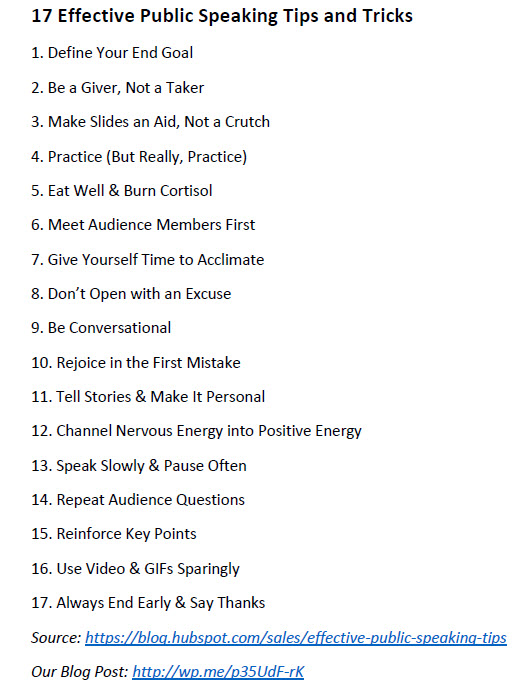
17 Effective Public Speaking Tips to Improve Your Speaking Skills

17 Effective Public Speaking Tips and Tricks
public speaking

When you think of impressive public speakers, they have their passion for their topic.

So the most important thing you can do is to get fired up about your topic. Find an angle that excites you, and the rest will come.

Here are the 17 Effective Public Speaking Tips that can help you get much better for your next presentation:

  1. Define Your End Goal
    The first thing to do when preparing a speech is to define your end goal. What do you want the audience to do after they leave the room? What information should they walk away with?
  2. Be a Giver, Not a Taker
    Once you’ve defined your end goal, build a presentation that offers real value to your audience, regardless of whether they pursue your product or service. Make any business pitches subtle and at the end of your presentation.
  3. Make Slides an Aid, Not a Crutch
    The American Speech-Language-Hearing Association recommends using keywords, instead of sentences or paragraphs on your slides. This helps your audience focus on your message.
    PowerPoint Do’s and Don’ts
    Do’s
    Use legible type size.
    Be brief.
    Use key words to help audience focus on your message.
    Enhance readability.
    Make every word and image count.
    Limit the number of slides.
    Don’ts
    Don’t overuse special effects.
    Don’t use more than eight words per line or eight lines per slide.
    Don’t use too many words or include non-essential information.
    Avoid hard-to-read color combinations.
  4. Practice (But Really, Practice)
    Maybe you’ve rehearsed your presentation by yourself, but haven’t run it by anyone else.
    Make sure you’re practicing your presentation in front of several groups of people.
    Ask for honest, critical feedback on the good, the bad, and the ugly of your presentation.
  5. Eat Well & Burn Cortisol
    Eating a protein-packed snack before a public speaking engagement boosts your energy, focus, and mood. Exercise one to three hours before you speak. You’ll feel less stressed and your audience will benefit from your focus.
  6. Meet Audience Members First
    It’s always a good idea to meet a few of your audience members before taking the stage.
    This is a great way to calm pre-presentation jitters.
  7. Give Yourself Time to Acclimate
    Many speakers begin talking immediately after being introduced or walking onstage. Instead, try approaching the stage in silence. This gives you time to gather your thoughts, take a deep breath, and get used to being in front of the audience.
  8. Don’t Open with an Excuse
    Don’t begin your presentation with an excuse. That makes the time about you, when it should be about your audience and how you can provide value to them.
  9. Be Conversational
    How do you make the most of that first few seconds of your presentation? First, be conversational. Use inflection in your voice and engage in natural, friendly body language.
  10. Rejoice in the First Mistake
    I wouldn’t recommend calling out the first mistake you make in front of your audience. Simply acknowledge your first mistake and view it as permission to relax and move on with your presentation.
  11. Tell Stories & Make It Personal
    Your audience is more likely to remember and share the stories you tell than the stats and figures you pack your slides with. Make your presentation personal, and remind them that you’re human.
  12. Channel Nervous Energy into Positive Energy
    If you’re not excited about your presentation, why would your audience be? One way to channel excitement into your public speaking is to transform nervous energy into positive energy.
  13. Speak Slowly & Pause Often
    Speaking slowly make it easier for your audience to understand. Routinely pause during your presentation can allow you to refocus and get attention from the audience.
  14. Repeat Audience Questions
    Try to repeat audience questions. It gives everyone a chance to hear what was asked. Repeating audience questions unsure that you’ve understood what the question is and give you an extra few moments to gather your thoughts.
  15. Reinforce Key Points
    Repeating key points at multiple times throughout your presentation helps your audience retain what’s most important.
  16. Use Video & GIFs Sparingly
    When appropriate, throw in a GIF or video. But make sure it aids in your storytelling, instead of distracting from it. A truly engaging public speaker will be able to present impactfully without gimmicks.
  17. Always End Early & Say Thanks
    Whether your audience gave you five minutes of their attention or an hour, end early and say, “Thank you.” Be respectful and always end early especially if you’re expecting a longer Q&A period.

Check here to download the shorter version of 17 Effective Public Speaking Tips and Tricks in pdf format for your easy reference.

Public speaking is an art, and one that can take years to perfect. Join Toastmasters and find a club that you like to practise your speeches in a friendly environments. You are welcome to visit our Kampong Ubi Toastmasters Club if you are living in Singapore.

17-Effective-Public-Speaking-Tips-and-Tricks

Share

Practical Public Speaking Tips to Engage Your Audience

Try These 5 Public Speaking Tips to Engage Your Audience and Make Your Next Pitch Sound Like a TED Talk

speaking tips

“The most popular TED Talks share five qualities that any entrepreneur or speaker can — and should — adopt in their very next pitch or presentation.”

  1. TED speakers are passionate.
    “Deliver presentations on topics you’re passionate about and don’t be afraid to express your enthusiasm about a subject. It’s contagious.”
  2. TED speakers tell stories.
    “Personal stories build trust between two people. Tell more stories to make a deeper, emotional connection with your audience.”
  3.  TED speakers use pictures
    “When you tell stories, make sure your slides have more pictures than words.  Simply put, pictures are more effective than text alone on a slide.”
  4. TED speakers keep it short.
    “TED Talks have a strict limit of 18 minutes. Why 18? According to Chris Anderson, 18 minutes is “short enough to hold people’s attention, including on the internet, and precise enough to be taken seriously. But it’s also long enough to say something that matters.”
  5. TED speakers put in a lot of practice
    “Rehearse repeatedly is a guideline that the TED conference gives its speakers. Your business presentation is a performance. Rehearse for it.”

You may never give a TED talk, but these five tips probably will help you stand out when you speak in your next presentation or business pitch.

If you want to overcome stage fright and learn to speak with confidence, join a Toastmasters Club.
You are welcome to visit our Kampong Ubi Toastmasters Club if you are living in Singapore.

Share

Useful Public Speaking Tips for Delivering an Effective Speech

16 Ways to Overcome Your Fear of Public Speaking

Fear of public speaking

  1. Know Your Stuff
  2. Practice, Practice, Practice
  3. Talk Yourself Down
  4. Wallow in the Worst
  5. Visualize the Outcome
  6. It is Not All About You
  7. When Things go Wrong
  8. Keep Calm, Don’t Rush It
  9. Focus on Getting Through the First 5 Minutes
  10. Never Apologize for Being Nervous
  11. Don’t Share Your Mistakes
  12. Arrive Early
  13. Stretch
  14. Breathe
  15. Double Check Everything
  16. Don’t Fight Your Stage Fright … Work With It

20 Useful Tips on Public Speaking

Public Speaking

  1. Exercise Beforehand
  2. Develop a Routine
  3.  Make Sure You’ve Eaten
  4. Prep First, Speak Later
  5. Start with a Bang
  6. Take Dramatic Pauses
  7. Don’t Give All the Answers
  8. Don’t Apologize
  9. Answer Questions
  10. Repeat Questions
  11. Get Personal
  12. Keep Slideshows Brief
  13. Don’t Rely on Slides
  14. Tell Your Audience Something New
  15. Don’t Try and Sell Something
  16. Have a Back-up Plan
  17. Always Repeat Yourself
  18. Hand Out Homework
  19. Know When to Zip It
  20. Try and Have Fun

Join Toastmasters and find a club that you like to practise your speeches in a friendly environments. You are welcome to visit our Kampong Ubi Toastmasters Club if you are living in Singapore.

Share

Can Toastmasters Help You Be a Better Public Speaker?

Have you heard of toastmasters?
Can Toastmasters help you to be a better speaker?

why join toastmasters

If you are or were a toastmaster, I think your answer to the above question is YES.
If you don’t know what toastmasters are. Check out the below videos.

“Why Join Toastmasters?”

The Schwan Food Company’s Chief Executive Officer from 2008 to 2013, Greg Flack, gave his personal testimony on the value of the Toastmasters program and explained how participating in Toastmasters helps people grow professionally and personally.

Why Toastmasters?

Tom Dowd presents at an open house at Lewiston-Auburn Toastmasters on February 7, 2012 about how Toastmasters International has made a profound difference in his life and career.

What is Toastmasters?

Also, you can check out the below article “Can Toastmasters Help You Be a Better Public Speaker” written by George Torok.

If you want to overcome stage fright and learn to speak with confidence, join a toastmasters club.

You are welcome to visit our Kampong Ubi Toastmasters Club if you are living in Singapore.

——–
Can Toastmasters Help You Be a Better Public Speaker?
By George Torok

The short answer is yes.

Toastmasters can help you improve your presentation skills. Toastmasters has helped hundreds of thousands of people around the world improve their presentation, public speaking, and communication skills. Continue reading

Share