Category Archives: Video

Public Speaking Video

Presentations – How To Give Good Presentations

“Presentations – How To Give Good Presentations”

good presentations


This video produced by Mohawk College describes some quick pointers on how to give good presentations.

Here is the transcript of the video.

I’m Dennis Angle I’m a professor of Mohawk College and this presentation is about presentations. Presentations, we have students to do it all the time. Presentations are in business, in school and in everyday life.

Two reasons we want to do a presentation. We want to inform somebody, and we want to convince somebody to do something. Practice, practice your presentation. Practice, practice, practice and practice again. It shows when you practice your presentation and it really shows when you don’t.

Practice in front of a mirror. Practice in front of your friends. Practice in front of your relatives. Practice in front of a big empty room or practice in front of a camera. You will become smooth.

PowerPoint
Use PowerPoints as a guide and a menu. Just put your main points on the PowerPoint. Put them there so people can remember. Put them there so you can remember what your main points are. Don’t put stuff that anyone can read and don’t read your PowerPoint slide. Everybody can read it they don’t need you to talk about it. Just put the main points on your PowerPoint.

Technology
Technology is okay.  But your presentation should be about the presentation and is not about the technology. Make sure you practice. Make sure you know what you’re doing. Make sure the technology you’re using is the same that you’re actually going to encounter in your presentation. Try and practice on the actual equipment.

Nervousness
Everybody gets nervous. Some people say try to picture everybody in their underwear. I tried that once. Tattoos, scars, birthmarks… It wasn’t pretty. I was still nervous.

My advice
Practice, practice and more practice and that will take away the nervousness. Know what you’re going to say. Know what you’re going to present. That should be all there is to it.

When you’re presenting, keep your sentences short and keep your sentences concise. People will remember your message. Don’t ramble. Don’t have really long sentences. Don’t put in a lot of ohms and ahhs. Take your time. Short sentences it’ll work. Your presentation needs an ending. Make sure you have an ending. The audience needs to know when to stand up and cheer and clap and applaud. If you’re going to have questions, save them till after your ending but make sure your presentation has an ending.


The following is an related article. Enjoy!

Powerpoint Presentations Are Great, But Are You Engaging Your Audience?

Getting an audience interested in your presentation is a challenge. No matter the technology used, whether it’s a PowerPoint, whiteboard, graphs, or other visual aids, it’s your delivery, preparation, or lack of it that will impinge on your performance.

The Buzz Is In The Telling
If you’ve been to a lot of seminars or webinars, you can count in your one hand the few which stood out. Ask yourself what you liked about those gigs. Probably these are the highlights:

1. Good presentation material.
2. Good reporting.
3. Great speakers.
4. Lively participants.

On hindsight, you’ll realize that what made the activity outstanding was your active participation in almost all activities. You asked a lot of questions and were satisfied with the answers, and you probably liked what you saw in almost all the PowerPoint presentations.

But it’s not actually the PowerPoint presentations that were interesting, it was what you understood. You learned something from the discussion, while PowerPoint only served as a visual aid. You were an active participant like the others. Nobody was ready to rush to the door. People wanted to know more and discuss more.

You got the point that the successful presentation was in the manner of showing the ideas and talking about them. The approach was able to draw out or engage the participants. Some of them remember the discussion and not the PowerPoint presentations at all.

Repetition and Anecdotes Count

You’ve observed that the speaker made the participants at ease. He didn’t have to crack lousy jokes. Simply asking how the people were feeling or if they were ready for the next round of discussion stirred people to action.

The speaker (already introduced) starts by telling the audience what he is going to discuss. During his discussion, he guides the audience by telling them that he is now ready to launch on the second or third or last part of his presentation. All the while, he invites people to ask questions.

He repeats what he has said as if driving the idea and embedding it into their minds. He does not only tell, but shows how things are done. To find out if people are on his wavelength, he asks questions, not only to test their comprehension, but to gauge the level of the audience interest as well. He is following the outlined course of his discussion, but makes sure that before launching the next step, his audience learned something.

He injected stories and parables to his repertoire, or provided analogies. These are subtle techniques used to repeat his theme and objective. At this extent, he has already grasped the group dynamics and responded accordingly.

Make Your Report Dynamic
It does not mean you don’t have to spruce up your PowerPoint presentations. Don’t make the mistake of cramming all the content in your slides. Your slide should serve as a clue to what you are going to elaborate. Remember the guy who read his slides without making eye contact with the audience? He was a bore.

Make an outline of your PowerPoint presentations while never losing sight of your objective. Guided by your plan and your thorough preparation (even a dry run to get an estimate of how long you’re going to present your ideas), you can be confident to engage your audience.


Practice Makes Natural.
Join Toastmasters and find a club that you like to practise your speeches in a friendly environments. You are welcome to visit our Kampong Ubi Toastmasters Club if you are living in Singapore.

Share

How to Use Hand Gestures in Public Speaking?

How to Use Hand Gestures in Public Speaking?

Do you know how to use hand gestures in public speaking?
What do you do with your hands?

Have you ever watched someone’s hand gestures when they are talking? Open hand gestures tend to make a person appear open and honest. Bringing hands together to a point can accent the point you are making.

Wringing your hands or excessively moving your fingers and hands will give away nervousness.

public speaking hand gestures

Read the article written by Jena McGregor and Shelly Tan dated November 17, 2015  (The Washington Post). It is a good reference for what to do with your hands while speaking in public.

What to do with your hands when speaking in public?

Here are the key points:

  1.  Keep hand movements descriptive.
  2.  Use open palm gestures to build the audience’s trust.
  3.  Keep your hands in the strike zone when possible.
  4.  Don’t point. Just don’t.
  5. Politicians love to use the “Clinton thumb.” Most people shouldn’t.
  6.  When you don’t know what to do, drop your hands to your sides for a moment.
  7. Avoid drawing attention to the wrong places.
  8. Conducting is for orchestras, not public speaking.
  9. Keep objects out of you hands.
  10. If behind a lectern, show your hands.
  11. Avoid “spider hands.”

The following youtube videos demonstrate how to use your hands – and how not to – while giving a presentation. I find these videos useful and would like to share with you.

Communication does not just consist of words. Less than 10% of the words we use in speaking gets through to others. On the other hand, over 55% of our body language is communicated to others very clearly. Whether you are trying to sell your product or service to a client or you are trying to persuade a group of people to change their behavior, it is critical that your words and gestures match. Many people have sabotaged their messages because their words were saying one thing, while their bodies were saying the exact opposite.

Can you think of a time when someone told you that he would be able to do something while his head was shaking no? Which did you believe, the words or the gesture? When your body movements are congruent with your words, your message will have a very powerful impact on your audience.

Gestures include your posture, the movement of your eyes, hands, face, arms and head, as well as your entire body. They help to support or reinforce a particular thought or emotion. If our gestures support our statements, we are communicating with a second sense. People tend to understand and remember messages better when more than one sense is reached.

Winston Churchill was a master at using gestures to powerfully bring home his point. During World War II, Churchill rallied the citizens of Great Britain to continue their fight against overwhelming odds. He often visited the neighborhoods of London, which had been devastated by bombs and walked through them with his fingers held up in the sign of a “V”. This victory sign accompanied his famous message, “Never give in. Never, never, never give in.” This gesture so powerfully communicated Churchill’s message that soon people gained greater resolve to continue fighting whenever they saw the victory sign.

People naturally use gestures in conversations. They are not on the spot, so they easily move their arms and hands and make facial expressions to illustrate the points they are trying to make. However, an amazing thing happens when people stand up in front of a group to speak. They suddenly think, “Oh no! What am I going to do with these things attached to my shoulders?” and they either don’t move them at all or they move them awkwardly. Gestures should be a natural extension of who we are. Presenters should strive to be themselves. They should be as spontaneous with their movements as if they were talking to their family or friends.

What are you doing with your hands? If you get nervous in social situations, you may feel that no matter what you do with your hands, it’s the wrong thing. Many people who cross their arms in front of their chest are probably doing so at least in part because they don’t know where else to put their hands.

You should never cross your arms in front of your chest unless you really don’t want anybody to approach you. That is the message this gesture sends out. If you want to look open and approachable, keep your arms at your sides. Holding your arm in front of your body can be seen as a signal that you want to defend yourself against other people.

Practice Makes Natural.
A good way to be comfortable with gestures is to know your speech well. Several of the most outstanding speakers offer the same piece of advice: “The key to effectively using gestures is to know your material so well, to be so well prepared, that your gestures will flow naturally.” Practice your speech and know it well so that you can enjoy sharing your message with others.

Join Toastmasters and find a club that you like to practise your speeches in a friendly environments. You are welcome to visit our Kampong Ubi Toastmasters Club if you are living in Singapore.

Share

8 Tips to Overcome Your Fear of Public Speaking

public-speaking-fear
Don’t you want to overcome your fear of public speaking?

Check out the below video for learning how to speak confidently in public.


Speaking in public is said to be one of mankind’s greatest fear. A fear of public speaking can occur in any environment and can impact us all.

Here is the list of the best tips to help you overcome your fear of public speaking.

Step 1: Time Perfect
Make sure that the speech delivered is appropriately timed .
Don’t overuse or under use the allocated time.

Step 2: Start Strong
The first 10 seconds of the speech will be how the audience judges you.
Start with a fact and something to make them laugh. This makes you relatable and genuine.

Step 3: Practice, Practice and Practice
Make sure you know the concept and core themes of your speech before you deliver it.

Step 4: Make Eye Contact
A good public speaker is some who is good at practicing for eye contact. The audience love to feel empowered and engaged with the speaker. Giving them eye contact achieves just that. Make sure to spread the eye contact amongst the audience.

Step 5: Body Language
Positive body language can enhance your presentation in ways words can’t.

Body language accounts for over 50% of your communication so use it effectively.

Step 6: Use Gestures
A good public speaker uses their natural gestural vocabulary as well as their words.

This means to use your hands to gesture whilst you present.

Step 7: Organize Your Speech Logically
Just like a good story a good speech also has logic and structure.

A simple three-part concept introduction middle and conclusion with a split of 20 60 20 is the norm.

Step 8: Connect With The Audience
Public speaking is about engaging with the audience and making it interesting for them to learn and understand. This can be accomplished through storytelling and advice.

Join Toastmasters and find a club that you like to practise your speeches in a friendly environments. You are welcome to visit our Kampong Ubi Toastmasters Club if you are living in Singapore.

Share

Highlights of World Champions of Public Speaking 2017

Here are the Results of World Champions of Public Speaking 2017:

Congratulations to Manoj Vasudevan of Singapore, District 80, on becoming the 2017 World Champion of Public Speaking.

Congratulations to Simon Bucknall, District 91, on finishing in second place.

Congratulations to Kevin Stamper, District 48, on finishing in third place for his speech.

Manoj Vasudevan World Champion of ‪Public Speaking 2017 Full Speech, “Pull Less, Bend More.”

Watch Manoj Vasudevan, the 2017 Toastmasters World Champion of Public Speaking—deliver his winning speech titled, “Pull Less, Bend More.” It’s about the power of being flexible in relationship.

Singapore management consultant wins Toastmasters’ 2017 World Championship of Public Speaking.

Here’s a breakdown of the speech that won the 2017 World Championship of Public Speaking:

  1. He immediately disarms his audience.
  2. He delivers his message clearly and concisely.
  3. He speaks as if he’s having a conversation.
  4. He lets his body language flow naturally.
  5. He adjusts his speech according to its reception.

Top 3 public speaking tips, according to the world champion of public speaking

“Public speaking can be daunting for some. But like any skill, it can be perfected with time.
Manoj Vasudevan, the 2017 Toastmasters World Champion of Public Speaking, says you can easily overcome this fear.”

Here are his top three tips on public speaking:

  1. Be a messenger (not just a speaker)
  2. Determine the ultimate goal of the speech
  3. Don’t just tell — sell

2nd Place Winner 2017 World Championship of Public Speaking – Simon Bucknall

“Watch Simon Bucknall, ACB, CL— second place winner of the 2017 Toastmasters World Championship of Public Speaking—deliver a speech titled, “What James Bullock Taught Me.” It’s about breaking down fear and hatred to achieve greater understanding among each other.”

3rd Place Winner 2017 World Championship of Public Speaking – Kevin Stamper

“Watch Kevin Stamper—the third place winner of the 2017 Toastmasters World Championship of Public Speaking—deliver a speech titled, “Speak Up.” It’s about the importance of finding your voice.”

Practice is the key to helping you improve on your communication and presentation skills. Join Toastmasters and find a club that you like to practise your speeches in a friendly environments.  You are welcome to visit our Kampong Ubi Toastmasters Club if you are living in Singapore.

P.S.
World Champions of Public Speaking Winning Speeches Playlist

Share

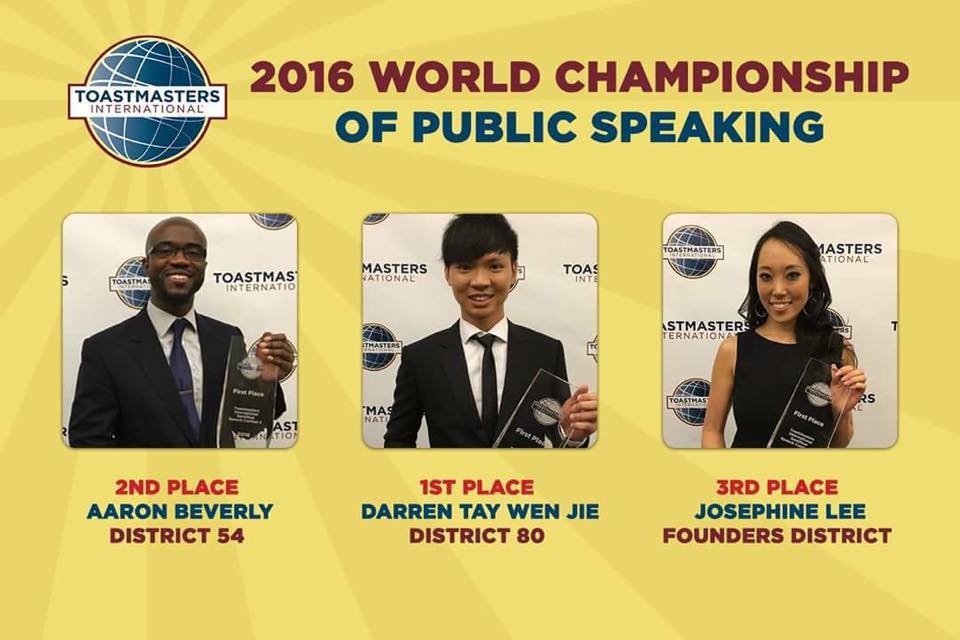
Highlights of World Champions of Public Speaking 2016

Here are the Results of World Champions of Public Speaking 2016:

World Champions of Public Speaking 2016

Congratulations to Darren Tay Wen Jie of Singapore, District 80, on becoming the 2016 World Champion of Public Speaking.

Congratulations to Aaron Beverly of Pennsylvania, District 18, on finishing in second place.

Congratulations to Josephine Lee of Founders District in California, on finishing in third place for her speech.
Source:http://www.toastmasters.org

Darren Tay Wen Jie World Champion of ‪Public Speaking 2016 Full Speech, “Outsmart; Outlast”.


Here’s a breakdown of the speech that won the 2016 World Championship of Public Speaking.
Source: http://www.businessinsider.sg/toastmasters-public-speaking-champion-darren-tay-2016-8

  1. He immediately disarms the audience
  2. He develops a message
  3. He lets that message guide his speech
  4. He effectively uses body language
  5. He has a dialogue with the audience

Singaporean lawyer wins the international public speaking championship.
Here is another press release about the event.

Highlights of 2nd place winner 2016 World Championship of Public Speaking – Aaron Beverly

Highlights of 3rd place winner 2016 World Championship of Public Speaking – Josephine Lee

Practice is the key to helping you improve your communication and presentation skills. Join Toastmasters and find a club that you like to practise your speeches in a friendly environment.  You are welcome to visit our Kampong Ubi Toastmasters Club if you are living in Singapore.

P.S.
World Champions of Public Speaking Winning Speeches Playlist

Share

Learn How to Prepare a Speech from a World Champion of Public Speaking

Learn How to Prepare a Speech from the 2014 Toastmasters International Word Champion of Public Speaking, Dananjaya Hettiarachchi.

winners-trophy

Dananjaya certainly knows how to deliver a great speech.
Check out the below video for learning how he prepares for his award-winning presentations.

Here is the Summary for the Three Keys to a Great Speech:

1. Have a very concise message that the audience can remember as well as recall it. You should be able to write your message in 10 words or less.

2. Have an attention-grabbing opening. It is now the responsibility of the speaker to hold the audience’s attention. Tell an interesting story. Use an anecdote or ask a rhetorical. Or you could frame a problem that is relevant to the audience in the form of a story so that the audience knows as to why they should listen to your speech. Frame the central problem in that first 45 seconds.

3. End the speech in a “high”.  A lot of speakers plateau and end in a “low”. When you are peaking, have a cold stop. This leaves the audience wanting more.

Since 1924 Toastmasters International has helped more than four million people gain the confidence to communicate. Join Toastmasters and find a club that you like to practise your speaking skills. You are welcome to visit our Kampong Ubi Toastmasters Club if you are living in Singapore.

Share