Author Archives: YY

How To Improve Your Presentations Skills?

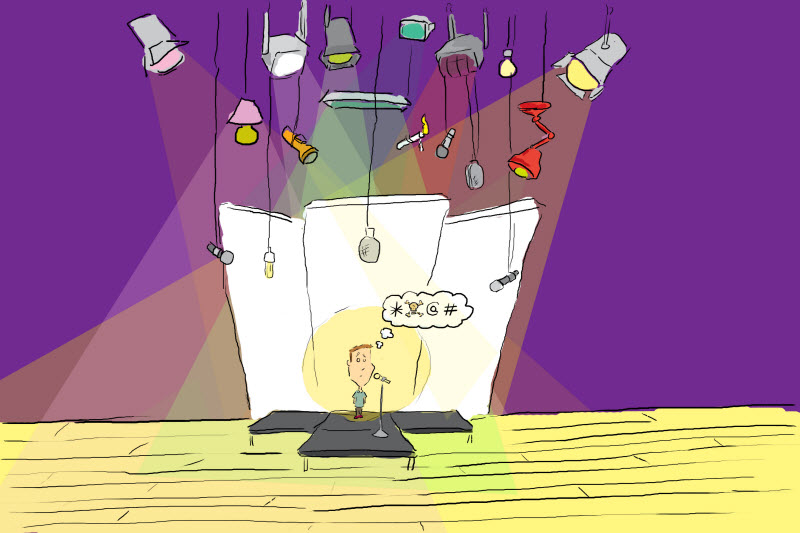
Have you tried everything from the books to improve your presentation skills and still feel the fear of public speaking? 

scared-lady

Check out the below 10 Ways to Improve Your Presentations Skills offered by 10 Forbes Coaches Council members.

Source: http://www.forbes.com/sites/forbescoachescouncil/2016/06/13/10-ways-to-improve-your-presentation-skills/

  1. Deconstruct What Great Speakers Do
    The internet gives us access to countless videos of the greatest speakers of our time. Deconstruct their speech by highlighting their approach, tactics and execution.
  2. Focus On Your Audience, Not Yourself
    By focusing on them, and what you plan to share, your focus becomes the content, not how you look or sound.
  3. Know Your Stuff So You Can Let Go And Be Yourself
    Practice your material so much that it becomes truly a part of you. Because the quality of a talk isn’t the content; it’s how well you connect with your audience.
  4. Get Specific About What You Need To Improve
    Get specific on what your weakness is by asking for targeted feedback. You can then attack the problem without spending unneeded time shooting in the dark.
  5. Create a Speaking Avatar
    Create a You 2.0. Fully imagine and visualize it. When it’s time to present, have your avatar take the stage.
  6. Join Toastmasters
    Joining a Toastmasters group in order to practice presenting in a non-threatening and supportive environment.
  7. Accept Constructive Criticism And Apply It
    To improve upon what you’ve read and learned, you must be willing to accept constructive criticism and apply it.
  8. Get Into Your Body More
    A frequent experience in speaking in front of a group is to lose connection with your body. Practicing some specific exercises, such as yoga, tai chi or dance, can help you gain body awareness and more control of your inner energy flow.
  9. Explore Your Self-Talk
    First, explore your self-talk. Gently pause those negative thoughts, and explore the positive ones.  Get comfortable inside first, and the rest will follow.
  10. Try Improv To Improve
    Step out of the box and onto a stage, specifically an improv class at a local theater or comedy club. These are phenomenal ways to force one’s brain to expand its limits of handling the pressure of a speaking situation. 

Join Toastmasters and find a club that you like to practise your speeches in a friendly environments. You are welcome to visit our Kampong Ubi Toastmasters Club if you are living in Singapore.

Share

Learn How to Prepare a Speech from a World Champion of Public Speaking

Learn How to Prepare a Speech from the 2014 Toastmasters International Word Champion of Public Speaking, Dananjaya Hettiarachchi.

winners-trophy

Dananjaya certainly knows how to deliver a great speech.
Check out the below video for learning how he prepares for his award-winning presentations.

Here is the Summary for the Three Keys to a Great Speech:

1. Have a very concise message that the audience can remember as well as recall it. You should be able to write your message in 10 words or less.

2. Have an attention-grabbing opening. It is now the responsibility of the speaker to hold the audience’s attention. Tell an interesting story. Use an anecdote or ask a rhetorical. Or you could frame a problem that is relevant to the audience in the form of a story so that the audience knows as to why they should listen to your speech. Frame the central problem in that first 45 seconds.

3. End the speech in a “high”.  A lot of speakers plateau and end in a “low”. When you are peaking, have a cold stop. This leaves the audience wanting more.

Since 1924 Toastmasters International has helped more than four million people gain the confidence to communicate. Join Toastmasters and find a club that you like to practise your speaking skills. You are welcome to visit our Kampong Ubi Toastmasters Club if you are living in Singapore.

Share

The Best 20 Public Speaking Tips from the TED Talks

a-good-emceePublic speaking is all about performance. Holding the interest of your audience throughout your presentation is an area documented in any public speaking course. Once you’ve learned ways to prepare your notes, conquered your fear of public speaking and brushed up your presentation skills, suggestions on great ways to captivate your audience is the next step.

While captivating an audience is a skill that takes years to develop, there are some simple ways to quickly improve your public speaking and presentation skills from the TED Talks.

Source: 20 Public Speaking Tips of the Best TED Talks

  1.  Always give the audience something to take home.
    Always provide something specific the audience can do almost immediately. No matter how inspiring your message, every audience appreciates learning a tangible way they can actually apply what they’ve learned to their own lives. Inspiration is great, but application is everything.
  2. Don’t defer answering questions.
    If a question pops up in the middle of your presentation, that’s awesome: Someone is listening! So seize the opportunity. If you would have addressed it in a later slide, skip ahead. 
  3.  Ask a question you can’t answer.
    Asking questions to engage the audience often feels forced. Instead ask a question you know the audience can’t answer and then say, “That’s okay. I can’t either.” Explain why you can’t and then talk about what you do know.
  4. Fuel your mental engine.
    Let’s start with some preparation tips. Dopamine and epinephrine help regulate mental alertness. Both come from tyrosine, an amino acid found in proteins. So make sure to include protein in the meal you eat before you need to be at your best.
  5. Burn off a little cortisol.
    Cortisol is secreted by your adrenal glands when you’re anxious or stressed. High levels of cortisol limit your creativity and your ability to process complex information; when you’re buzzed on cortisol, it’s almost impossible to read and react to the room. The easiest way to burn off cortisol is to exercise.
  6. Create two contingency plans.
    If you’re like me, “What if?” is your biggest source of anxiety: What if your PowerPoint presentation fails, someone constantly interrupts, or your opening falls flat? Pick two of your biggest fears and create contingency plans.
  7. Establish a pre-routine.
    Instead of creating a superstition, create a routine that helps center you emotionally. Walk the room ahead of time to check sight lines. Check microphone levels. Run through your presentation at the site to ensure it’s ready to go.
  8. Set a backup goal.
    You should always have two goals in mind: one that you really want to achieve, and another that you’ll aim for if the first doesn’t work out. Why should you be prepared to give up on your primary goal? It will allow you to walk away from one failed attempt without feeling like a complete failure.
  9. Share a genuinely emotional story.
    Tell a story and let your emotions show. If you were sad, say so. If you cried, say so. If you felt remorse, let it show. When you share genuine feelings you create an immediate and lasting connection with the audience. Emotion trumps speaking skills every time.
  10. Pause for 10 seconds.
    Pause for two or three seconds and audiences assume you’ve lost your place; five seconds, they think the pause is intentional; after 10 seconds even the people texting can’t help looking up. When you start speaking again, the audience naturally assumes the pause was intentional … and that you’re a confident and accomplished speaker.
  11. Share one thing no one knows.
    Find a surprising fact or an unusual analogy that relates to your topic. Audiences love to cock their heads and think, “Really? Wow…”
  12. Benefit the audience instead of “selling.”
    Put all your focus on ensuring that the audience will benefit from what you say; never try to accomplish more than one thing. When you help people make their professional or personal lives better, you’ve done all the selling you’ll need to do.
  13. Don’t make excuses.
    Due to insecurity, many speakers open with an excuse: “I didn’t get much time to prepare”¦” or, “I’m not very good at this.” Excuses won’t make your audience cut you any slack, but they will make people think, “Then why are you wasting my time?” Do what you need to do to ensure you don’t need to make excuses.
  14. Don’t do your prep onstage.
    Don’t wait until you’re onstage to check your mic, your lighting, your remote, or your presentation. And if something does fail, smile and try to look confident while you (or others) take care of the problem. When things go wrong, what really matters is how you react.
  15. Don’t overload your slides.
    Roughly speaking, your fonts will be between 60 and 80 points. If you need to fit more words on a slide, that means you haven’t tightened your message.
  16. Don’t ever read your slides.
    Your audience should be able to almost instantly scan your slides; if they have to actually read, you might lose them. And you’ll definitely lose them if you read to them. Your slides should accentuate your points; they should never be the point.
  17. Focus on earning attention.
    Make your presentation so interesting, so entertaining, and so inspiring that people can’t help but pay attention. It’s not the audience’s job to listen; it’s your job to make them want to listen.
  18. Always repeat audience questions.
    Unless microphones are available, rarely will everyone in the audience hear questions other audience members ask. Always repeat the question and then answer it. It’s not only courteous, but it also provides you with a little more time to think of an awesome way to answer each question.
  19. Always repeat yourself.
    Create a structure that allows you to repeat and reinforce key points. First explain a point, then give examples of how that point can be applied, and at the end provide the audience with action steps they can take based on that point. What you repeat has a much greater chance of being remembered–and being acted upon.
  20. Always, always run short.
    If you have 30 minutes, take 25. If you have an hour, take 50. Always respect your audience’s time and end early. Finish early and ask if anyone has questions. But never run long–because all the goodwill you built up could be lost.

Join Toastmasters and find a club that you like to practise your speeches in a friendly environments. You are welcome to visit our Kampong Ubi Toastmasters Club if you are living in Singapore.

Share

Most Shared Public Speaking Tips on Facebook

public speaking

Here are some of the most shared articles about public speaking tips on Facebook from the past 12 months:
Source: buzzsumo.com

10 Tips to Beat Your Fear of Public Speaking

  1. Prepare.
  2. Understand your fears.
  3. Loosen up.
  4. Be human.
  5. Tell a Joke.
  6. Keep it light.
  7. Pause.
  8. Don’t try to sell something.
  9. Don’t fear your audience.
  10. Be willing to make mistakes.

7 tips for becoming an excellent public speaker

  1. Practice transitioning from a transcript to your memory.
  2. Use notes sparingly.
  3. Release nervous energy with controlled breathing and lay off the coffee.
  4. Take your time.
  5. Place to your strengths.
  6. Don’t apologize at the start of your speech.
  7. Know your audience.

The 17 Public Speaking Tips You Can’t Afford to Ignore

  1. You don’t have to tell them what you’re going to tell them.
  2. Cut, cut, cut!
  3. An entire story is designed to serve the end.
  4. The speech starts with your bio, before you walk onstage.
  5. Establish right away that you know what the world looks like for them—and what it could look like.
  6. Reward your audience for participating or contributing in some way.
  7. Use open hands with your palms up instead of your finger for pointing.
  8. People say yes when we’ve affected them intellectually, emotionally or physically.
  9. Outline your content and then unpack it.
  10. Use props.
  11. Use contrast and extremes to create excitement and keep attention.
  12. Keep moving forward. Never let your energy drop.
  13. Audiences like to think that events on the stage are happening spontaneously.
  14. Stand and land.
  15. You can move and talk at the same time.
  16. Don’t say, “I’m glad to be here.” Show them that you’re glad to be there instead.
  17. Don’t tell them you’re going to tell a story. Just tell the story.

Command The Crowd: 3 Tips To Overcome Your Fear Of Public Speaking

  1. Focus on your breathing.
  2. Practice three times as much as you think you need.
  3. Visualize the situation.

#1 Tip for Getting Past the Fear of Public Speaking

  • Don’t focus on yourself. Shift the focus from YOU to the AUDIENCE.

Since 1924 Toastmasters International has helped more than four million people gain the confidence to communicate. Join Toastmasters and find a club that you like to practise your speaking skills. You are welcome to visit our Kampong Ubi Toastmasters Club if you are living in Singapore.

Share
Fear of public speaking

Useful Public Speaking Tips for Beginners

Powerful Public Speaking Tips for Beginners

Public speaking can be really daunting!

Fear of public speaking

Here are some useful public speaking tips for beginners:

1. Open with a story.
2. Eliminate fears before you go on stage.
3. Know your content.
4. Be prepared for tech failures.
5. No one wants you to fail.

For details, please check out the below YouTube video.


Check out the following speaking tips too.

18 Powerful Public Speaking Tips For Absolute Beginners
Source:  https://www.linkedin.com/pulse/18-powerful-public-speaking-tips-absolute-beginners-haldorsen

1. Act In-Spite of Yourself – Just Do It!
2. Always Build On Your Strengths
3. Practice with People You Know and Feel Comfortable With (Including Yourself in The Mirror!)
4. Record yourself to Train your Voice and Body Language
5. Carefully Study and Emulate Your Favorite Public Speaker(s)
6. Become a Serious Armchair Public Speaking and Body Language Expert
7. Work on Ditching The Notes
8. Have Plans for the Unexpected
9. Do Pre-Event Promotion
10. Add Social Sites to your Actual Presentation – Especially Twitter!
11. Establish a Pre-Speaking Routine
12. Exercise and Breath before Your Speech
13. Thank Your Audience When You’re Done
14. Analyze Your Performance For Next Time
15. Don’t Talk Right Away
16. Never Start with An Apology
17. Show up to Give, Rather than Take
18. Choose to Turn Your Nervous Energy into Contagious Excitement

Join Toastmasters and find a club that you like to practise your speeches in a friendly environments. You are welcome to visit our Kampong Ubi Toastmasters Club if you are living in Singapore.

Share